
Professional Review: Irix 11mm Cinema Lens
Irix Cine 11mm T4.3 (Feet)
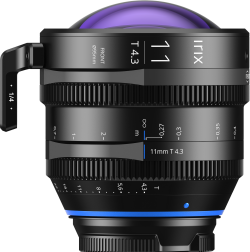
Available in Canon EF, Arri PL, Canon RF, Sony E, Nikon Z, L-Mount, MFT, and Fuji X
Ultra HD 8K Ready Optics with Superb Image Resolution
Rectilinear Ultra Wide Angle of View (Not a Fish-Eye lens)
Military Grade Protection to shoot in any weather conditions. Irix Cine Lenses have received the Military Grade MIL-STD-810 certification for Freezing Rain/Icing and Humidity
Engraved Markings with UV-Reactive Paint for Low-Light Situations
9 Rounded Aperture Blades for Extraordinary Image Quality
Focus Breathing close to Zero
Low Distortion
Standard 0.8 Pitch Mod Gears
Internal Focusing
Summary
Meet Peter, a freelance filmmaker based in Hawaii who understands the importance of good gear in the filmmaking business. According to Peter, the camera lens, or glass, is one of the most important pieces of gear that every filmmaker should invest in. In his recent review, Peter tests the 11mm T4.3 cinema lens by Irix and shares his unbiased opinion. The lens has 9 aperture blades, a 0.8 gear pitch with 75 degrees throw, and a 180-degree focus throw. It weighs in at about 1105 grams and has a 95mm front diameter. What's more, all of Irix's lenses are weather-sealed and cover full frame, making them perfect for 8K resolution. At less than $1,200, the 11mm T4.3 ultra-wide cine lens is priced really well and is 8K ready. For more information, visit Irixlens.com.
Professional Review: Irix 11mm Cinema Lens
Hi there, my name is Peter and I am a freelance filmmaker that's based in the beautiful islands of Hawaii. Now, as most of us know, gear is a pretty important part of this filmmaking business, and in this day and age we live in the land of options. Too many options in my opinion, but hey, I'd rather have options than none.
Now depending on your line of work, or just the specific role that you might be in, or the department that you work with, cinema lenses might not be in your everyday conversations. But I have to say that the camera lens, or as we like to call it, glass, is probably one of the most important gear that you can own. Some might even say that it's the best investment that you can make in your filmmaking career, and I have to agree with them. Because no lens, well, your camera is just not going to be able to produce an image.
Now cinema lenses in general are going to be very expensive, because it's just the way it's built, how it's built, the materials that they use, and just how precise each lens has to be, and just the list goes on and on. However, thankfully, like cameras and equipment for the most part recently, have gotten way more affordable over the years, and so have cinema lenses.
Now there are plenty of other videos out there discussing in depth about cinema glass, but today I will be talking about a cinema lens from a company called Irix. Now Irix has been in the business of making photo lenses for quite some time now, but actually recently, I'd say in the past two to three years, they have released four cinema lenses. We have the 11, the 15, the 45, and the 150mm macro lens, with more lenses to be announced in the near future.
Now I've had these lenses for about two weeks now, and I've put them through its paces, tested the limits, examined its flaws, you name it, I did it. Well, I didn't do a drop test, so not everything, but because I do have to return these lenses, but in these reviews, I will cover key features, focus breathing, flare, bokeh, and we'll pixel peep to see how sharp these lenses are, and see if there are any distortions or any chromatic aberration.
So let's just get right into it and check out the 11mm T4.3 by Irix. Now I really like their packaging, as you can tell that they've put some thought into it. I like the fact that, you know, right off the bat, you see all of the contents that will come in the box, as well as all of the features of that lens. In the box, you receive a good old manual, you know, like an actual nice physical manual. You don't really see that nowadays, but you also get a foot with two screws and an Allen key. And what's nice about this lens is actually, all of their cinema lenses is that you'll have an option to mount the foot on the bottom or the top of the lens.
Now build quality seems very good. Personally, I like heavy cinema lenses. It's, you know, it's probably a psychological thing, but something that's lightweight can seem cheap. Obviously, that's not true with everything, but I like that it's heavy. So looking at the key features of this lens, the weight comes in at about 1,105 grams. That's about two and a half pounds. So it's got some weight to it. All of Irix lenses are made out of high grade aluminum housing with all metal internal construction, with the exception of this adaptive ring, which is a pretty cool feature to have if you're using like a certain focus motor or gear as it allows it a little bit more room.
First off, this lens is a T4.3 all the way to T22 with nine aperture blades. Now according to Irix, for them to achieve this excellent optical performance while maintaining a reasonable weight in this price segment, they were able to settle at T4.3. Like most cinema lenses, it has an aperture ring with a standard 0.8 gear pitch with 75 degrees throw. The rotation is nice and smooth with good resistance for both aperture and focus rings. The focus ring is also really nice with the focus throw of 180 degrees. From top to bottom, this lens is about 105 millimeters. That's four inches.
I really like the fact that it's compact and just the perfect size. All of this information can actually be found on their website at Irixlens.com and I really like their website as it's really easy to navigate and all the information that you ever need for each lens is on there.
Now back to this beautiful 11 millimeter lens. It has a 95 millimeter front diameter, but as you can tell, you won't be able to screw on any filters on it because the front element is protruding. Now this next feature I found really impressive and in fact, all of their lenses has this and that is that their lenses are weather sealed. And I just find this pretty amazing and I think pretty rare on a cinema lens. All of Irix lenses actually cover full frame and are all 8K ready.
Now for all of these four lenses that I'll be testing, I went with the EF mount as I will be pairing it up with my RED Komodo. Now Irix does make an RF mount, which the Komodo has a native RF mount, but since most of the glass that I own is EF, I went with EF. Now another reason why I went with EF is because there are several companies that make an RF to EF adapter with a variable ND in it. Now what's so great about that is that you don't have to really worry about screwing on an ND in the front and deal with step up rings and step down rings. But especially with this lens, you're going to need that ND behind the lens because you won't be able to screw anything on this guy because of the front element. Now the Komodo sensor has a crop factor of about 1.3, making this 11mm lens roughly a 14mm full frame equivalent.
So let's just take it for a spin and see what this bad boy can do. Now I was able to take advantage of this ultra wide 11mm lens by showcasing this $5 million home in Hawaii. Now at T4.3 this is obviously not a fast lens, but when you're trying to capture say the beauty of a landscape or architecture, you don't really need a super shallow depth of field because you want everything in focus. Speaking of focus, focus breathing is present but not overly exaggerated and at this wide of a lens is pretty common and in my opinion totally acceptable. Bokeh is nice and round starting at T4.3 and throughout higher T stops. Flare is controlled pretty well with some nice red and green orbits in the middle. Chromatic aberration is there if you really pixel peep and of course in those backlit shots, but it's controlled pretty well considering. Also there's no vignetting on my Komodo so that's really good, it's just one less thing to fix in post. Perspective distortion or the pin cushion effect is obviously there being that it's so wide, but the barrel distortion is actually controlled really well.
Now I do believe that this lens is meant for a specific type of work like landscape shots or even real estate or if you just want that unique perspective. It's not meant for everything but I think most of us know this. Overall I really like this lens, build quality is solid, it's nice and compact. Now the price
Highlights:
- Build quality is solid
- Nice and compact
- Weather sealed and 8K ready
- Ultra sharp
- Comes in multiple mounts
- Reasonably priced at less than $1,200
- Aperture ring with standard 0.8 gear pitch
- Smooth focus ring with 180 degree throw
- No vignetting on Komodo